

Project Deliverables
-Update Cult Base UX to better guide players with completing follower objectives and base management tasks (ex. cleaning and resource collection).
-Redesign the tarot card powerup system to help players define card selection, identify new cards, and showcase card art in a way to show its rarity.
Project Deliverables
-Update Cult Base UX to better guide players with completing follower objectives and base management tasks (ex. cleaning and resource collection).
-Redesign the tarot card powerup system to help players define card selection, identify new cards, and showcase card art in a way to show its rarity.
What is Cult of the Lamb?
Cult of the Lamb is an adorably dark game that blends dungeon crawling and cult-themed base-building, where you play as a lamb on a mission to become the one true cult leader.
What is Cult of the Lamb?
Cult of the Lamb is an adorably dark game that blends dungeon crawling and cult-themed base-building, where you play as a lamb on a mission to become the one true cult leader.
Reason for Redesign: Base Management UX
Cult of the Lamb has a short Day and Night cycle and if not careful, base management can become overwhelming in early game. During the play through portion of research, findings show that early game base maintenance became overwhelming due to the amount of areas that needed tending to. Cleaning and gathering opportunities would be missed resulting in followers getting sick or a loss of supplies. This made the early base game loop frustrating and tedious.
Reason for Redesign: Base Management UX
Cult of the Lamb has a short Day and Night cycle and if not careful, base management can become overwhelming in early game. During the play through portion of research, findings show that early game base maintenance became overwhelming due to the amount of areas that needed tending to. Cleaning and gathering opportunities would be missed resulting in followers getting sick or a loss of supplies. This made the early base game loop frustrating and tedious.

Uh...which one did I choose again? I’m not sure.
So many chores! There’s poop at the top, dead bodies on the left, berries on the right, and bed are broken...

Uh...which one did I choose again? I’m not sure.

So many chores! There’s poop at the top, dead bodies on the left, berries on the right, and bed are broken...

The item counter UI was helpful, but I hardly saw it being used in my playthrough.
The item counter UI was helpful, but I hardly saw it being used in my playthrough.

Design Spotlight: Distance-Based Notifications
The idea for a persistent notification came about when looking at the structure crafting tutorials and the floating item counter used for task progression. This previous player experience could be used as a solution for base management where the floating item counter acts as a notification for cleaning, follower tasks, and more. While some of these tasks may become automated in late game progression, The plan for the solution was based off the three hours of playtime with the game.
Research Findings: Cult of the Lamb is a roguelite base-builder that takes occult theming and horror imagery and presents it in a cute and cuddly wrapper. The UI Density is kept pretty low which reflects the simple art style. During my early game play through I found it frustrating when I would have one or several areas to maintain, but I would miss an item to interact that would result in a follower getting sick or a loss of resources.
One other issue that I would run into was picking the wrong power up from one an NPC. I found myself wanting a better solution for highlighting the selected powerup, tracking new powerups, and showcasing the game art that differentiates the rarity of a powerup.
Design Spotlight: Distance-Based Notifications
The idea for a persistent notification came about when looking at the structure crafting tutorials and the floating item counter used for task progression. This previous player experience could be used as a solution for base management where the floating item counter acts as a notification for cleaning, follower tasks, and more. While some of these tasks may become automated in late game progression, The plan for the solution was based off the three hours of playtime with the game.

Not only is the UI meant to point in the direction of the interactable at long distances, but its also meant to stay oriented along the border of the screen to avoid obscuring the player's view.

The floating notification scales based on distance. If the lamb is far, the UI grows. If the lamb is near the interactable, the UI shrinks.
Prototype: Distance-Based Notification 1
Prototype: Distance-Based Notification 2
Prototype: Distance-Based Notification 1
Design Spotlight: Distance-Based Notifications
The idea for a persistent notification came about when looking at the structure crafting tutorials and the floating item counter used for task progression. This previous player experience could be used as a solution for base management where the floating item counter acts as a notification for cleaning, follower tasks, and more. While some of these tasks may become automated in late game progression, The plan for the solution was based off the three hours of playtime with the game.
Reason for Redesign: Tarot Card Redesign
Roguelike games rely on randomized upgrades to drive player engagement and replayability. Cult of the Lamb implements this mechanic through 85 tarot cards that players can choose from. However, the card selection interface had three notable issues discovered during research: insufficient information displayed when presenting new cards, unclear visual feedback for the selected card, and card animations that obscured the card illustrations
Cult of the Lamb Prototype
Prototype: Distance-Based Notification 2
Cult of the Lamb Prototype
Prototype: Distance-Based Notification 1

Not only is the UI meant to point in the direction of the interactable at long distances, but its also meant to stay oriented along the border of the screen to avoid obscuring the player's view.
The floating notification scales based on distance. If the lamb is far, the UI grows. If the lamb is near the interactable, the UI shrinks.


Readability is good when looking at common cards, but…
By adding animation and different effects, selecting a tarot card becomes confusing.
Cult of the Lamb Prototype
Prototype: Tarot Card Redesign
Research into card-based games, particularly Pokémon TCG, presented design solutions for Cult of the Lamb's tarot card system.
The first issue was resolved by adding a new card indicator give players clear feedback when encountering new cards. The solution leverages existing player knowledge by reusing the exclamation icon from the Inventory Menu ensuring familiarity and visual consistency.
The second issue was resolved by retaining the red selection border, but enhanced with blur effects, multiply layers, and motion to create stronger visual feedback when selecting cards.
The third issue was resolved by displaying card rarity without animations obscuring the card illustrations. Inspired by Pokémon TCG's holographic card borders, the solution utilized multiple layered effects: metallic borders (silver for uncommon, gold for rare), glowing effects using the card's existing green and purple text colors, directional panning animations that moved only across the black portions of the illustration, and decorative sparkle vectors to emphasize rarity while preserving the artwork.
Design Spotlight: Designing Tarot Cards
Reason for Redesign: Tarot Card Redesign
Roguelike games rely on randomized upgrades to drive player engagement and replayability. Cult of the Lamb implements this mechanic through 85 tarot cards that players can choose from. However, the card selection interface had three notable issues discovered during research: insufficient information displayed when presenting new cards, unclear visual feedback for the selected card, and card animations that obscured the card illustrations
Readability is good when looking at common cards, but…
By adding animation and different effects, selecting a tarot card becomes confusing.
Design Spotlight: Designing Tarot Cards

Common Card (Recreated)

Uncommon (Reworked)
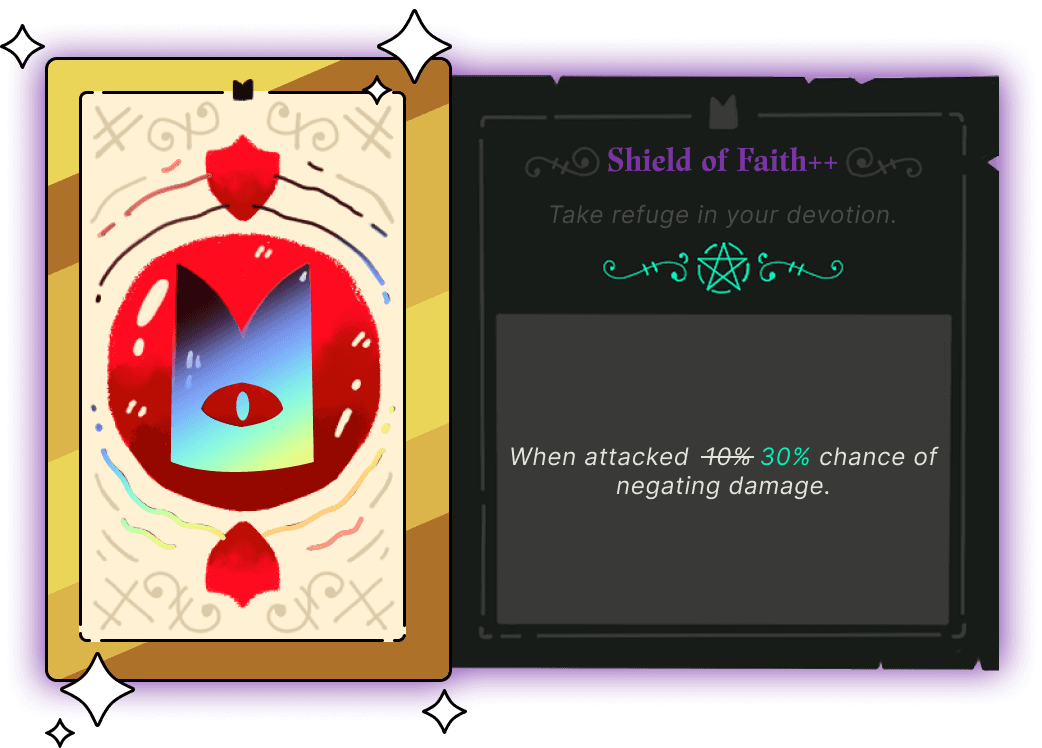
Rare (Reworked)
Research into card-based games, particularly Pokémon TCG, presented design solutions for Cult of the Lamb's tarot card system.
The first issue was resolved by adding a new card indicator give players clear feedback when encountering new cards. The solution leverages existing player knowledge by reusing the exclamation icon from the Inventory Menu ensuring familiarity and visual consistency.
The second issue was resolved by retaining the red selection border, but enhanced with blur effects, multiply layers, and motion to create stronger visual feedback when selecting cards.
The third issue was resolved by displaying card rarity without animations obscuring the card illustrations. Inspired by Pokémon TCG's holographic card borders, the solution utilized multiple layered effects: metallic borders (silver for uncommon, gold for rare), glowing effects using the card's existing green and purple text colors, directional panning animations that moved only across the black portions of the illustration, and decorative sparkle vectors to emphasize rarity while preserving the artwork.
Prototype: Tarot Card Redesign
Final Thoughts and Future Plans
There were three key takeaways that reinforced crucial lessons of game UI design
Clear Cohesive Design: A impactful design solution requires multiple parts working towards a single goal. In the tarot card redesign, motion, focus, and visual hierarchy work in tandem to clearly communicate the card's rarity. Clarity should never require guesswork.
Leverage Learned Patterns: Many design challenges have already been solved in other games; the key is knowing how to translate their solutions to other games. The rare card treatment from Pokémon TCG, for example, provided a solution for Cult of the Lamb's rarity system. Researching existing solutions accelerates the design process and ensures proven approaches support design decisions.
Discovering Solutions in Design Solutions: The most valuable insight was recognizing that solutions can reveal deeper issues. While working on the Base UX issue, the assumed problem was initially a lack of visual indicators. However the redesign process suggested the real issue may be more fundamental. Future work should investigate whether the true issue is information architecture, player expectation, or onboarding clarity rather than visual feedback.
Final Thoughts and Future Plans
There were three key takeaways that reinforced crucial lessons of game UI design
Clear Cohesive Design: A impactful design solution requires multiple parts working towards a single goal. In the tarot card redesign, motion, focus, and visual hierarchy work in tandem to clearly communicate the card's rarity. Clarity should never require guesswork.
Leverage Learned Patterns: Many design challenges have already been solved in other games; the key is knowing how to translate their solutions to other games. The rare card treatment from Pokémon TCG, for example, provided a solution for Cult of the Lamb's rarity system. Researching existing solutions accelerates the design process and ensures proven approaches support design decisions.
Discovering Solutions in Design Solutions: The most valuable insight was recognizing that solutions can reveal deeper issues. While working on the Base UX issue, the assumed problem was initially a lack of visual indicators. However the redesign process suggested the real issue may be more fundamental. Future work should investigate whether the true issue is information architecture, player expectation, or onboarding clarity rather than visual feedback.