Cult of the Lamb Description: Cult of the Lamb is an adorably dark game that blends dungeon crawling and cult-themed base-building, where you play as a lamb on a mission to become the one true cult leader.
Project Deliverables: Update Cult Base UX to better guide players with completing follower objectives and management tasks (ex. cleaning and resource management).
Cult of the Lamb Description: Cult of the Lamb is an adorably dark game that blends dungeon crawling and cult-themed base-building, where you play as a lamb on a mission to become the one true cult leader.
Project Deliverables: Update Cult Base UX to better guide players with completing follower objectives and management tasks (ex. cleaning and resource management).

Uh...which one did I choose again? I’m not sure.
So many chores! There’s poop at the top, dead bodies on the left, berries on the right, and bed are broken...

Uh...which one did I choose again? I’m not sure.

So many chores! There’s poop at the top, dead bodies on the left, berries on the right, and bed are broken...

This UI element is helpful, but I hardly saw it being used in my playthrough.
This UI element is helpful, but I hardly saw it being used in my playthrough.
Cult of the Lamb has a short Day and Night cycle and if you’re not careful, base management can become overwhelming. While playing, I’ve noticed that the tutorial had a helpful floating checklist for a recipe that would inform the player of what items they needed for building structures.
As a solution to early game base management, I decided to use the idea of the floating checklist as a way to alert the player to address certain areas around their base.
Cult of the Lamb has a short Day and Night cycle and if you’re not careful, base management can become overwhelming. While playing, I’ve noticed that the tutorial had a helpful floating checklist for a recipe that would inform the player of what items they needed for building structures.
As a solution to early game base management, I decided to use the idea of the floating checklist as a way to alert the player to address certain areas around their base.

Research Findings: Cult of the Lamb is a roguelite base-builder that takes occult theming and horror imagery and presents it in a cute and cuddly wrapper. The UI Density is kept pretty low which reflects the simple art style. During my early game play through I found it frustrating when I would have one or several areas to maintain, but I would miss an item to interact that would result in a follower getting sick or a loss of resources.
One other issue that I would run into was picking the wrong power up from one an NPC. I found myself wanting a better solution for highlighting the selected powerup, tracking new powerups, and showcasing the game art that differentiates the rarity of a powerup.
The point of interest widget would scale depending on the players proximity and trace the screen’s border giving the player which direction to go in.
The point of interest widget would scale depending on the players proximity and trace the screen’s border giving the player which direction to go in.


One main feature of a roguelite game is encountering randomized upgrades. This requires players to adopt different approaches on each run. I tried to pick different items and upgrades on my runs to see which combinations synergize with each other; however two things prevented me from playing this way—unclear upgrade selection and a lack of identifying new upgrades.

The point of interest widget would scale depending on the players proximity and trace the screen’s border giving the player which direction to go in.


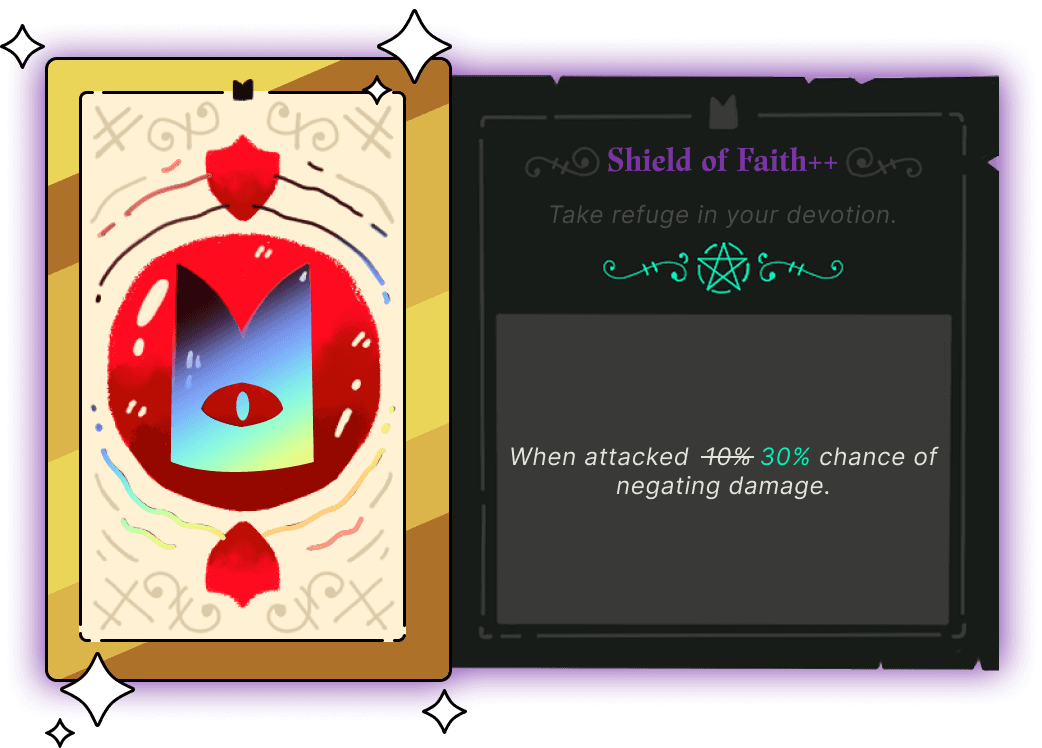
While there are designs for the tarot card upgrades to differentiate rarity, some of the effects and colors not only made readability of the illustration of the card difficult, but also made selecting the desired upgrade confusing.
I created different versions for card rarity with unique colors and effects as well as creating a “!” icon to inform the player that there is a new card to choose from.

One main feature of a roguelite game is encountering randomized upgrades. This requires players to adopt different approaches on each run. I tried to pick different items and upgrades on my runs to see which combinations synergize with each other; however two things prevented me from playing this way—unclear upgrade selection and a lack of identifying new upgrades.
While there are designs for the tarot card upgrades to differentiate rarity, some of the effects and colors not only made readability of the illustration of the card difficult, but also made selecting the desired upgrade confusing.
I created different versions for card rarity with unique colors and effects as well as creating a “!” icon to inform the player that there is a new card to choose from.